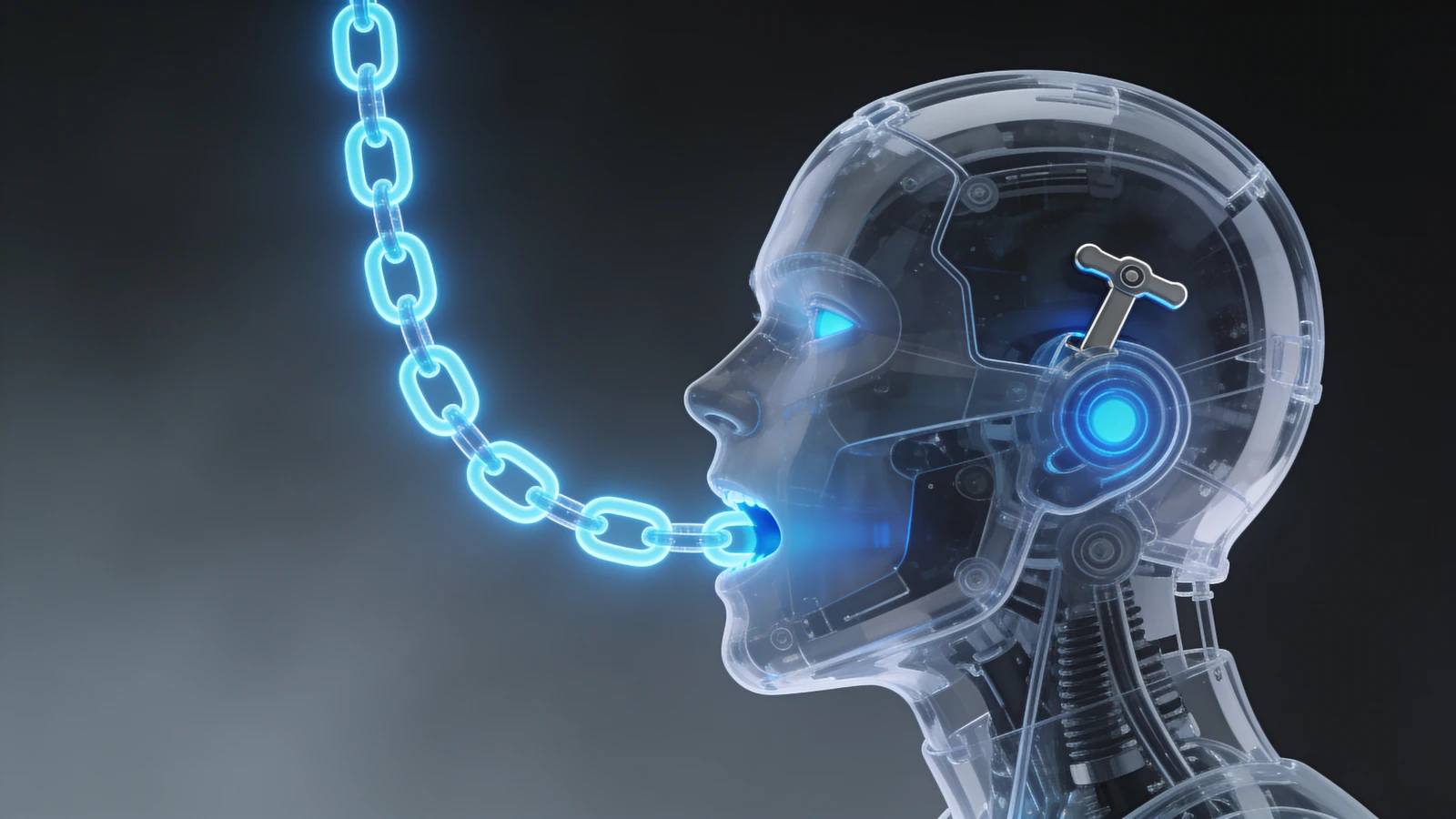
Model Collapse Is a Replace Problem, Not a Synthetic Data Problem
The famous model collapse result comes from a loop that throws the real data away. Here is what the Nature paper and its follow-ups actually show, and why labs still train on synthetic data.
Model collapse is real, but the famous result is about a specific setup: each new model trains only on the output of the model before it, and the real data is thrown away. Keep the real data, add synthetic data on top of it, and filter that synthetic data against something outside the model, and the degradation mostly stops showing up.
That distinction matters because "AI is eating its own tail" has become a stock argument in two directions at once. One camp says the web is filling with model output, so future models are doomed. The other points at labs training heavily on synthetic data and doing fine. Both are reading the same papers. They are just reading different experimental conditions.
What the Nature paper actually showed
The paper most people mean is AI models collapse when trained on recursively generated data by Shumailov and colleagues, published in Nature in July 2024 (an earlier preprint circulated as The Curse of Recursion). The language-model experiment is simple. Fine-tune a small OPT model on a Wikipedia-derived dataset. Use it to generate a new dataset of the same size. Fine-tune the next model on that generated data. Repeat for several generations.
Two things happened. First, the models got more confident about common sequences and lost the rare ones: the tails of the distribution thinned out generation after generation. Second, errors compounded: later generations started producing sequences the original model would almost never have produced. The paper's memorable example is a prompt about medieval church architecture that, by the ninth generation, degenerates into a list of jackrabbit varieties.
The authors split the damage into two stages:
- Early collapse: the model loses information about low-probability events. Average quality can look fine; what disappears is the long tail (rare words, minority dialects, unusual facts, edge cases).
- Late collapse: the distribution converges toward something with very little variance that no longer resembles the original data.
They also named three sources of error that compound across generations: statistical approximation error (a finite sample simply misses rare events, so the next model never sees them), functional expressivity error (the model family cannot represent the true distribution exactly), and functional approximation error (the training procedure itself has biases). The first one is the important one, and it does not need a bad model. Sampling from any distribution a finite number of times underrepresents its tails, and if the next model learns only from that sample, the tail is gone for good.
The detail that gets left out
The same paper ran a second setting in which 10% of the original human data was kept in each generation's training set. Degradation in that setting was small. That result is in the paper, not in a rebuttal, and it is the first hint that the scary curve depends on throwing the real data away.
Replace versus accumulate
The cleanest follow-up is Is Model Collapse Inevitable? by Gerstgrasser and colleagues (2024). They compared two loops directly:
- Replace: each generation trains only on data produced by the previous generation (the Nature setup).
- Accumulate: each generation trains on the original real data plus every synthetic dataset produced so far. The pool only grows.
In a linear regression setting they could solve analytically, replacing data makes test error grow steadily with the number of generations, while accumulating keeps it under a finite bound no matter how many generations you run. They then checked the same pattern empirically on transformer language models, diffusion models and variational autoencoders. Replace degraded; accumulate stayed roughly flat.
The intuition is not complicated. In the replace loop, every generation is a lossy copy of a lossy copy, and nothing ever restores what the previous copy dropped. In the accumulate loop, the original data keeps pulling the model back toward the true distribution, and each new synthetic batch is a shrinking fraction of the total.
Other results that point the same way
Self-Consuming Generative Models Go MAD (Alemohammad and colleagues, 2023) studied image models in three loops: fully synthetic, synthetic plus a fixed real dataset, and synthetic plus fresh real data each generation. Without enough fresh real data, either quality or diversity declined over generations. They also found something practically important: when the generator samples with a bias toward "good-looking" outputs (the cherry-picking that every real pipeline does), quality holds up longer but diversity collapses faster. Curation hides collapse rather than preventing it.
A Tale of Tails (Dohmatob and colleagues, 2024) framed the problem through scaling laws. Synthetic data from a model is missing the tail of the real distribution, so training on it changes the scaling curve: past a point, more synthetic data stops buying lower loss, because the information it would need to teach was never in it.
| Training loop | What each generation trains on | What the research found | Real-world analogue |
|---|---|---|---|
| Replace | Only the previous model's output | Tails disappear first, then variance collapses; error grows with every generation | Rare in practice; closest is a small model distilled repeatedly from itself |
| Fully synthetic with selection bias | Previous output, filtered for quality | Looks good longer, but diversity falls faster | Pipelines that keep only the "best" generations without a diversity check |
| Accumulate | Real data plus all synthetic data so far | Error stays bounded across generations | Web-scale pretraining where model text is a growing share of a mostly human corpus |
| Real data plus verified synthetic | Real data plus synthetic samples checked by an external signal | Synthetic data improves targeted skills | Code with unit tests, math with checkers, rejection sampling in post-training |
Why labs train on synthetic data anyway
If replacing data is dangerous, the obvious question is why synthetic data is now standard in post-training. The answer is that production pipelines almost never run the replace loop, and the best ones inject information the generating model did not have.
The early public example is Microsoft's phi-1 work, Textbooks Are All You Need (2023), which trained a small code model largely on filtered web code plus "textbook-style" material and exercises generated by a larger model, and got coding scores far above what its size suggested. Since then, open technical reports from several labs describe synthetic data used for instruction tuning, rejection sampling and reasoning distillation, where a large reasoning model's traces are used to fine-tune smaller ones.
Three things separate this from the collapse experiments:
- A different, stronger teacher. Distilling from a larger model is not the same as a model eating its own output. The student can inherit the teacher's blind spots, but it is not compounding its own sampling errors generation after generation.
- An external verifier. When generated code must pass tests, or a generated math answer must match a checker, the filter adds information from outside the model. That is the opposite of the statistical approximation error that drives collapse: instead of losing signal, the loop gains it.
- Real data stays in the mix. Synthetic data is layered onto human-written corpora, not substituted for them.
The verifier point deserves emphasis because it is where pipelines quietly go wrong. If the "filter" is another model's judgment, you have not added outside information, you have added that judge's preferences, including the position, length and self-preference biases of LLM judges. A judge that prefers fluent, confident, middle-of-the-distribution answers is a selection bias toward the center, which is exactly the MAD paper's recipe for losing diversity.
The open question: the web as an accumulate loop
The worry about the public web is better framed as an accumulate loop with an unknown, growing synthetic share, not as the replace loop. Crawls keep their human text; model-generated text gets added on top. By the research above, that is the less dangerous regime. But there are two real problems that the experiments do not fully cover.
Provenance is lost. In a lab experiment you know which samples are synthetic. In a crawl you mostly do not, and detectors for model-written text are unreliable. That is why some practitioners treat pre-2023 crawls the way physicists treat low-background steel: valuable precisely because they predate the contamination. It is the same provenance problem behind benchmark test sets leaking into training data, except here the leak is the model's own style rather than an answer key.
Model output carries more than its content. Research on subliminal learning and emergent misalignment found that fine-tuning on data generated by a model can transmit that model's traits even when the data looks unrelated to them. Collapse research measures distributional narrowing. It does not measure what else rides along in synthetic text.
There is also a quieter effect that matters more than catastrophic collapse for most teams: the slow loss of tails. Early collapse does not show up in average benchmark scores. It shows up as a model that is slightly worse at rare languages, unusual APIs, minority dialects and long-tail facts, which are exactly the cases that average-case evals underweight.
What this means if you generate training data
Most teams touching this are not pretraining frontier models. They are fine-tuning on synthetic instruction data, distilling a large model into a small one, or building eval sets with model help. The research translates into a short list of habits:
- Never fine-tune only on your own model's output. Keep a real-data anchor in every training mix. The Nature paper's 10% setting and the accumulate results both say a real-data share does most of the protective work.
- Accumulate, do not overwrite. When you regenerate synthetic data with a newer model, add it to the pool and keep the old real data. Version datasets so you can tell which generation produced which rows.
- Prefer verifiers over judges. Tests, schema validation, exact-match checkers and execution feedback add real information. A second model's opinion mostly adds its biases.
- Measure diversity, not only quality. Track distinct n-grams, embedding spread, coverage of rare categories and long-tail eval slices across dataset versions. Collapse is visible there long before it is visible in mean accuracy.
- Deduplicate aggressively. Synthetic data is repetitive by nature, and near-duplicates silently up-weight the center of the distribution. Even exact-match deduplication of a JSONL dataset (an NDJSON dedup pass catches the trivial cases) before semantic dedup is worth doing.
- Track provenance per row. Store which model, prompt and filter produced each synthetic sample. You cannot reason about collapse in a dataset whose origins you cannot see.
Takeaway
"Models trained on AI output collapse" is true for a loop almost nobody runs on purpose: replace the real data with the last model's samples, again and again. The risk in practice is subtler. Tails thin out when real data is a shrinking share, when the filter is another model's taste, and when nobody tracks which rows came from where. Keep the human data, accumulate rather than replace, verify against something outside the model, and watch your long-tail metrics. That is most of the defense the research supports.
Try it
Free, in your browser, no sign-up.
New posts by email
One email when a new post goes up. No other mail; unsubscribe in one click.
We store your email only to send new posts. See the privacy policy.